
AGE VERIFICATION EXPLAINED
- What is age verification?
- Why is online age verification important?
- How are governments approaching age verification?
- Which US States & Countries have age verification laws?
- How age verification works
- 4 trusted methods for age verification
- Does the end user have to verify their age every time?
- The importance of where age checks appear on websites
- The importance of privacy and data protection
- Conclusion
Age verification is here to stay. More & more countries & US states are introducing legislation for online platforms to implement legally approved age gates. Here we explain everything you need to know about age verification and why it is necessary in today’s digital world.
WHAT IS AGE VERIFICATION?
Online age verification is the process of confirming that a user meets the minimum age requirements before accessing websites or apps that feature age-restricted content, products, or services. This privacy-first digital age check helps businesses follow laws that protect minors from harmful content while still being able to give access to adult customers. Traditionally, websites and apps used a simple declaration pop up where a user would be able to click a tick box ‘Yes I am +18 years old’ or enter their date of birth. This is no longer acceptable to access age-restricted content, products or services in many countries. Where stringent laws have been introduced over the last couple of years. Requiring online platforms to use a method that provides a credible proof of user age through document verification, biometric checks, or third-party data validation.
WHY IS ONLINE AGE VERIFICATION IMPORTANT?
The primary reason is to protect children from online harm and this is being addressed by preventing children from:
✓ Exposure to pornography, self-harm material, and extreme violence.
✓ Access to online platforms that could contain adults looking to groom minors.
✓ Exposure to social media’s “addictive design” features (infinite scroll, gambling-like mechanics) that can cause psychological harm to children.
HOW ARE GOVERNMENTS APPROACHING AGE VERIFICATION
Governments worldwide are requiring enforceable age verification (AV) mandates. This approach involves passing legislation that holds platforms legally responsible for verifying the age of their users, with significant fines for non-compliance. Laws demand the use of methods like biometric age estimation, government ID uploads, and digital wallets, The aim is to balance child safety with a privacy-first protection for end users that verify their ages.
WHICH US STATES & COUNTRIES HAVE AGE VERIFICATION LAWS
While the discussion on age verification has existed for over a decade, 2025 was the year where legal enforcement began and continues in 2026. Here is a timeline of age verification laws and processes in different countries:
Currently over 25 states (including Texas, Florida, and Virginia) now require government-issued ID or biometric verification for adult content and iGaming. |
| |
France | As of April 2025, France mandates a “double anonymity” standard. According to France’s ARCOM Guidelines (opens in a new tab), Adult content sites must verify age through an independent third party so that the website never sees the user’s identity, and the verifier never knows which site the user is visiting. |
|
United Kingdom | Enforced fully in July 2025, the Online Safety Act (opens in a new tab) requires “highly effective” age assurance. Ofcom can now fine platforms up to 10% of global turnover for failing to protect children from “Priority Harms” like pornography and gambling. |
|
Enforcement began in November 2025, mandating that all adult content platforms integrate with Italy’s SPID (Digital Identity System) (opens in a new tab) or use certified third-party vendors for every single browsing session. |
| |
Germany introduced new regulations aimed at preventing financial institutions from offering payment services to adult websites that lack adequate age verification systems. This went into effect December 2025. In addition, the German Commission for the Protection of Minors in the Media (KJM) (opens in a new tab) has drawn up a test catalog (AVS Matrix) with the aim of evaluating age verification systems through a positive assessment procedure. |
| |
Spain | Spain introduced the law: Ley Orgánica de Protección de los Menores en los Entornos Digitales (opens in a new tab). From February 2026, Spain has banned children under the age of 16 from accessing social media and will adopt other measures to increase control over digital platforms and ensure that their executives are held accountable for violations. In addition, the CNMC (Comisión Nacional de los Mercados y la Competencia) (opens in a new tab) has been sanctioning Spanish websites with adult content, if they do not implement age verification following the Spanish Audiovisual Law (Ley 13/2022, de 7 de julio, General de Comunicación Audiovisual (opens in a new tab)). |
|
Australian law requires platforms to use verification methods like photo ID, facial age estimation, or digital ID to confirm users are over 18. Detailed in the eSafety Commissioner Policy (opens in a new tab). The law is applicable from March 2026 and applies to websites, social media platforms, app stores, AI chatbots capable of generating explicit content, cloud storage services, messaging services, online games rated 18+, and certain device manufacturers. In addition there is a Social Media Ban: Under-16s are prohibited from maintaining accounts on designated social media and messaging platforms. |
| |
Since March 17, 2026, Brazil’s Law 15.211/2025, the Digital Statute of Children and Adolescents (ECA Digital), has been in force. It sets protections for children in digital environments, including age verification requirements: self-declaration of age is no longer enough. Online platforms hosting adult content must enforce age barriers, prohibiting minors from accessing or creating accounts. |
| |
The EU | The European Commission is working toward an EU-harmonized approach to age verification. The Commission made a blueprint (opens in a new tab) for an age verification solution available on July 14, 2025. It allows users to prove they are over 18 without sharing any other personal information. Apart from being privacy-preserving, it is user-friendly and fully interoperable with future EU Digital Identity Wallets. |
|









HOW AGE VERIFICATION WORKS
The majority of websites and apps use a third-party age verification solution such as AgeGO. They use an age gate, but what is an age gate? When a user goes to an age restricted website or app, before the user can see any of the content, an age gate widget appears asking the user to verify their age.
From here a user can select from several different age verification methods. Each method must comply with guidelines from each country’s legislation, for example UK Online Safety Act compliance (opens in a new tab) overseen by Ofcom.
4 TRUSTED METHODS FOR AGE VERIFICATION
AgeGO has a waterfall approach that allows users to verify their age using different age verification methods, while guaranteeing double anonymity. These include the best biometric authentication solutions for online age verification. AgeGO never sees the user’s identity. Check out our Trust & Safety webpage. Here are 4 trusted age verification methods:
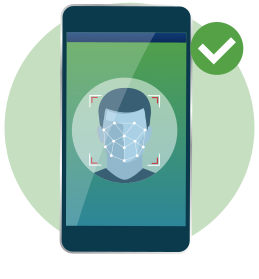
METHOD 1
Selfie
Taken with a mobile device or laptop/PC webcam, which utilizes age estimation, to ascertain a user’s age for verification.
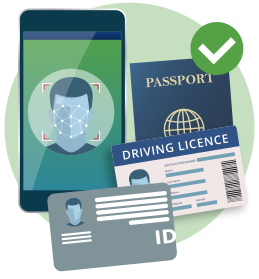
METHOD 2
Selfie + ID
This method matches a selfie image with a scan of an official Government photo ID document to verify a user’s age.

METHOD 3
Credit Card
In some countries, holding a credit card implies the user is over 18, so it can be used as an age verification method.
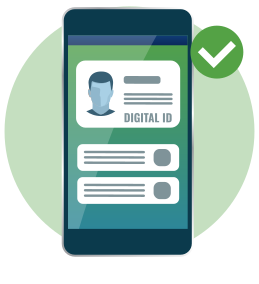
METHOD 4
Digital ID
This method uses a downloadable 3rd party app: Yoti Digital ID to verify the user’s age.
DOES THE END USER HAVE TO VERIFY THEIR AGE EVERY TIME?
The advantage with AgeGO, is that once the user has verified their age, and the verification result is ‘yes this user is 18 years old or over’ the user has the option to create an AgeGO account. Now the end user can enter any website or app that uses AgeGO as its age verification solution, without having to verify their age every time for a frictionless user experience.
THE IMPORTANCE OF WHERE AGE CHECKS APPEAR ON WEBSITES
If you want to know the best practices and how to set up and age gate on a website, the UKs Ofcom recently published guidelines (opens in a new tab) explaining why the specific placement of age checks or age gates on adult content websites, is important to protect minors. Its recommendations are to use a Front Gate solution.
Ofcom mentions 4 types of age gates that are commonly used.
Front Gate
A user only sees a blank landing page, with no content visible until the age check has been completed successfully. This is Ofcom’s recommended method which offers full minor protection.
Blur Gate
A user sees a series of blurred images before the age check. In some cases, titles are visible which could contain strong sexual wording. Clicking on a thumbnail directs users to an age check.
Image Gate
A user sees a series of clearly visible SFW images. In some cases, titles are visible which could contain strong sexual wording. In some variations, users can see a preview of the video when hovering over with a cursor. Clicking on the thumbnail directs users to an age check.
In-Video Gate
A user sees a series of thumbnails that contain clearly visible images. Often these are of clothed people, sometimes in sexually suggestive poses and/or wearing lingerie. In some cases, titles are visible which could contain strong sexual wording. Users can sometimes see a preview of the video when hovering over with a cursor. Users can then watch the video up until a certain point, usually up until nudity is shown, after which they are directed to an age check.
THE IMPORTANCE OF PRIVACY AND DATA PROTECTION
Data and privacy requirements for age verification demand that systems be privacy-preserving, using minimum data to confirm a user’s age without revealing their identity or the website the user is trying to access. The age verification is generally carried out through decentralized technologies. Systems must not store personal documents, must prevent user tracking/profiling, and ensure security through encryption.
Solutions such as AgeGO ensure that the age verification status is the only information AgeGO provides to the websites using the age verification service. See our Trust & Safety webpage for full details about data handling and privacy.
CONCLUSION
In conclusion, age verification has become a critical requirement in today’s digital landscape, driven by growing concerns around child safety and stricter global regulations. As governments continue to enforce robust standards, businesses must adopt reliable, privacy-first solutions that go beyond outdated self-declaration methods. By combining secure technology, user-friendly processes, and compliance with evolving laws, solutions like AgeGO enable platforms to protect minors effectively while maintaining frictionless access for adult users.