
AgeGO TRUST AND SAFETY
1. INTRODUCTION & PURPOSE
This is AgeGO’s Trust & Safety page. This is a regularly updated page to address concerns about using AgeGO as an end user. The purpose is to be fully transparent and provide details on our service.
AgeGO was founded in 2018 and is based in Barcelona, Spain. It is part of EXOGROUP, a group of companies offering a range of services within the digital business landscape.
As various countries and US States quickly introduce new laws to ensure +18 content websites verify the age of their users, it is important for age verification platforms like AgeGO to learn from feedback, reports and journalists’ questions so that we can better the service that we provide.
AgeGO is determined to create the best possible age verification product on the market. To ensure AgeGO is safe to use and respects end user data privacy while meeting the standards set out by the regulatory bodies and specific laws that have been created for age verification. During this learning phase for all online age verification solutions currently on the market, AgeGO has decided that all legitimate concerns will be addressed on this Trust & Safety page.
→ Summary: AgeGO is committed to transparency, learning from feedback, and ensuring privacy while meeting legal requirements for age verification.
2. TRUST & SAFETY PRINCIPLES
This section details AgeGO’s business values that define the company’s mission.
AgeGO has 6 core values:

PROTECTION:
Keep minors safe by ensuring adult content is accessed only by adults.
TRUST:
Protect user data with secure, privacy-first age verification.

SAFETY:
Make age verification simple, safe, and reliable for everyone.

TRANSPARENCY:
Be open and accountable to users and partners.

LIBERTY:
Adults should have free access to lawful content.

COMPLIANCE:
Help websites to meet legal obligations worldwide.
→ Summary: AgeGO’s core values are protecting minors, safeguarding user data, ensuring safety, being transparent, respecting adults’ freedom, and following the law.
3. LEGAL COMPLIANCE & ALIGNMENT WITH GOVERNMENT ENFORCEMENT AGENCIES
This section is dedicated to how AgeGO works in tandem with all age verification legal requirements and enforcement agencies to provide a fully compliant age verification solution.
This includes alignment with national regulators such as Ofcom (opens in a new tab) (UK) and Arcom (opens in a new tab) (France), which actively oversee compliance in their jurisdictions.
The European Union is also working on an all-encompassing solution to age verification for all members of the bloc. Details can be found in their Digital Strategy Policy for age verification (opens in a new tab). AgeGO is monitoring this closely to ensure that we are fully aligned with the EU requirements and follow their framework for our age verification service.
In the United States, age verification requirements are enforced through a combination of federal and state laws. While there is no single federal framework, various regulations govern access to age-restricted products and services, and state-specific rules may impose additional requirements.
AgeGO continuously reviews its systems to remain aligned with all current legal standards.
AgeGO is independently certified under ISO/IEC 27566-1:2025 and ACCS 1:2025 for age assurance and age verification systems.
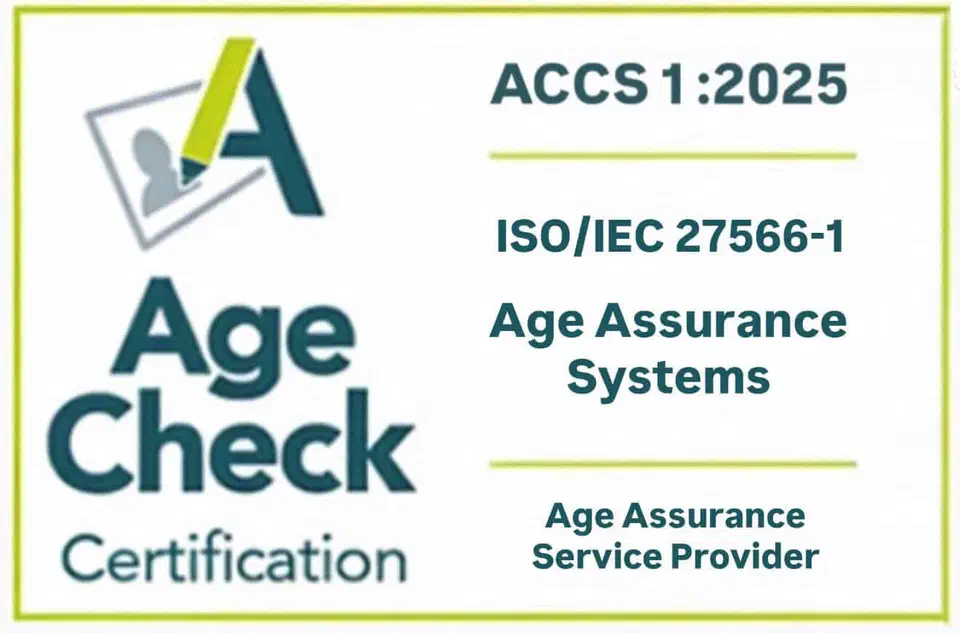
View the official registry listing here (opens in a new tab)
AgeGO has also been positively assessed by the German media regulator KJM (Commission for the Protection of Minors in the Media), which means that AgeGO’s age-checking technology meets the strict legal requirements of German youth protection laws.

More information here
→ Summary: AgeGO stays aligned with regulators in the UK, France, Germany, EU, and the US, and continuously adapts to evolving laws and standards worldwide.
4. TECHNOLOGY & VERIFICATION METHODS
This section details important information regarding AgeGO’s technology platform and verification methods.
AgeGO offers several verification methods:
Selfie with ID Fallback
When using this method, the process functions as follows:
a. The end user captures a live Selfie, with specific movements required to ensure liveness and prevent impersonation attempts.
b. AgeGO (internally) or a trusted third-party provider analyzes the image to verify that the user is a physically present human.
c. A trusted third-party provider estimates their age based on facial features.
d. In some cases, the Selfie cannot conclusively determine whether the end user is 18 or above. In such cases, the end user is asked to provide a photo of their ID.
e. If the trusted third-party provider confirms that the document is from an individual being 18 or above, the third-party provider performs a facial matching check between the ID and the Selfie captured beforehand to ensure consistency.
✓ A successful verification using this method is when the Selfie third party provider could successfully estimate that the user is an adult; or that the Selfie and ID third party providers could verify that the user is 18 or above.
ID + Selfie
When using this method, the process functions as follows:
a. The end user captures a live Selfie, following specific movements required to ensure liveness and prevent impersonation attempts.
b. AgeGO or a trusted third-party provider analyzes the image to verify that the user is a physically present human. This step is mandatory and a prerequisite; if the Selfie does not pass this initial verification, the process cannot continue.
c. Once the Selfie is validated, the end user is prompted to upload a Government-issued photo ID. The system validates the authenticity of the document and extracts the user’s date of birth.
d. To ensure consistency and ownership, the third-party provider performs a facial matching check between the previously captured Selfie and the photo on the ID document.
✓ A successful verification using this method is when the third-party provider confirms that the ID document is authentic, the user meets the required age threshold, and the facial matching confirms that the Selfie and ID belong to the same person. Both steps are mandatory in this verification method.
Digital ID
When using this method, the end user is redirected from AgeGO to a secure third-party provider mobile app, where they may be required to provide personal identification data (such as a valid government-issued ID). The trusted third-party provider processes this information within its own systems to confirm whether the end user meets the required age threshold.
✓ A successful verification using this method is when the third party provider responds that the age has been verified.
Credit Card
When using this method, the end user is asked to provide their credit card details (card number, expiration date, and CVV), which are transmitted directly from the end user’s browser to the third-party provider.
✓ A successful verification using this method is when the third party provider responds that it is a credit card and the 0€ pre-authorization transaction succeeded.
AgeGO Log In
Users have the possibility to prove their age by logging into their existing and verified AgeGO account. Indeed after their first age verification, users have the option to create such an account by providing their email address and confirming ownership using a 6-digit code sent to their email.
✓ A successful verification using this method is when the user successfully logs in to his/her age verified AgeGO account.
→ Summary: AgeGO offers multiple verification methods (selfie, ID, digital ID, or credit card), all processed by trusted providers. Privacy is guaranteed through “double anonymity”: websites never see your identity, and providers never know which site you visit.
5. END USER ONLINE SAFETY & DATA PRIVACY
This section provides current and updated information about how AgeGO ensures age verification end user privacy and data protection is maintained.
AgeGO does not store:
✘ Personal Documents
✘ Selfie (Permanent storage)
✘ Credit Card
✘ IP
✘ User-Agent
Or any data used to verify your age. That is handled by trusted third-party providers which are:
● Selfie with ID Fallback (Amazon Web Services EMEA SARL & Klippa App B.V.)
Images stored for a maximum of 1 hour.
The Liveness Detection (to confirm you are a real person) is performed either directly by AgeGO, where images are deleted immediately or within a maximum of 15 minutes, or through Amazon Web Services EMEA SARL as indicated above.
● Digital ID (Yoti Ltd)
Data retention is governed by Yoti’s Policies (opens in a new tab), with end users retaining full control of their Digital ID.
● Credit Card (Shift4 Payments LLC)
Card details are only processed during the transaction and stored for a limited time, following PCI standards.
Each provider operates under strict privacy and security standards, ensuring that end user data remains secure, confidential, and separate from AgeGO’s systems.
When a user creates an account, AgeGO stores:
✓ Encrypted Email Address
✓ Age Verification Status (Verified / Not Verified)
✓ Account Creation Date
✓ Verification Method Used
Users who have created an account may choose to delete it at any time. AgeGO does not retain any information once an account has been deleted.
The age verification status is the only information AgeGO provides to the websites.
AgeGO is ICO Certified. For more details on the processing of personal data, please refer to the AgeGO Privacy Policy.
→ Summary: AgeGO never permanently stores personal ID, selfie, or payment data. These are handled by trusted third party providers, except for the selfie, which may be processed transiently by AgeGO for Liveness Detection. AgeGO itself only stores an encrypted email if you create an account, and websites only get a simple “verified” or “not verified” result.
6. FREQUENTLY ASKED QUESTIONS
This section answers common questions about AgeGO’s age verification processes, providing transparency and reassurance about privacy, security, and anonymity.
What information does AgeGO share with the third-party providers during the age verification process?
AgeGO does not share any information from the users, the websites being accessed or the type of content being accessed with the third-party providers. It only identifies itself as the AgeGO service, to initiate the process with them.
As with any standard internet communication, the IP address and User-Agent are transmitted by the browser. Their transmission is not specific to AgeGO and does not constitute a disclosure of sensitive or personal data beyond what is inherent to standard web communications.
Note: In cases where AgeGO performs the Liveness Detection internally, only a single static frame of the selfie is subsequently transmitted to the third-party provider for the final age estimation.
Could a third-party recognize an end user if they have used AgeGO before?
No. Third-party providers cannot recognize returning end users because all data is deleted after the verification process. Without retained information, it is impossible to link multiple verifications to the same individual.
Does AgeGO store my IP address or User-Agent?
No. AgeGO does not store your IP address or User-Agent.
Does AgeGO comply with Arcom’s “double anonymity” principle?
Yes. The age verification methods labeled “double anonymity” meet Arcom’s specific requirements.
These methods rely on trusted third-party providers to process the verification data and AgeGO never discloses which website, page, or URL the end user is visiting.
To clarify, when using a verification method labeled “double anonymity”:
✓ The third party providers do not know which website is visited.
✓ The website only gets confirmation that a user is of legal age.
✓ The website cannot identify the end user or learn how their age was verified.
✓ AgeGO does not collect, process or store the data used to verify the age.
✓ AgeGO only manages the minimum information required to operate safely, ensuring that no verifications can be linked together.
Is account creation required?
We recommend that end users create an AgeGO account, but this recommendation is based on making the verification process safer and more user-friendly rather than on collecting unnecessary data. Users generally prefer not to repeat full age verification each time they access a service.
However, AgeGO does not mandate the creation of a user account to complete age verification.
What happens if I skip creating an account?
If you choose to skip account creation, AgeGO will not create or store any permanent user records. You will still be able to access the website without providing an email address.
Since no account is created, you will need to complete the age verification process again on your next visit.
You can skip registration at any time, even if you have already entered your email address and received a confirmation code, by clicking the “Skip AgeGO registration” link. In this case, your email address is used solely to send the confirmation code, which is stored securely for up to 15 minutes and then automatically deleted.
Does AgeGO comply with the GDPR’s data minimization principle?
Yes. AgeGO strictly adheres to the GDPR principle of data minimization by collecting and retaining only the information strictly necessary for its operations.
→ Summary: AgeGO does not share site URLs, does not track users, does not require accounts, and complies with GDPR and Arcom’s anonymity rules. Each verification is independent and cannot be linked.
7. FUTURE COMMITMENTS
This section details AgeGO’s planned commitments to improve its policies, reporting tools and technology.
We are currently working on a list of safety goals:
✓ Commission regular independent privacy and security audits.
✓ Launch a responsible disclosure program for researchers.
✓ Proactive regulatory adaptation by continuously monitoring, assessing and implementing any newly introduced age verification regulations across all relevant jurisdictions.
✓ Alignment with EU guidelines by closely following the European Commission’s proposed blueprint for age verification and any emerging guidance on best practices for age verification, aiming to meet or exceed the recommended standards.
→ Summary: AgeGO will continue improving by monitoring regulations, aligning with EU guidelines, seeking third-party certifications, and enhancing systems with regular reviews and audits.